
Collage Gallery
The Singing Wires
Collage, cut-and-paste and digital media.
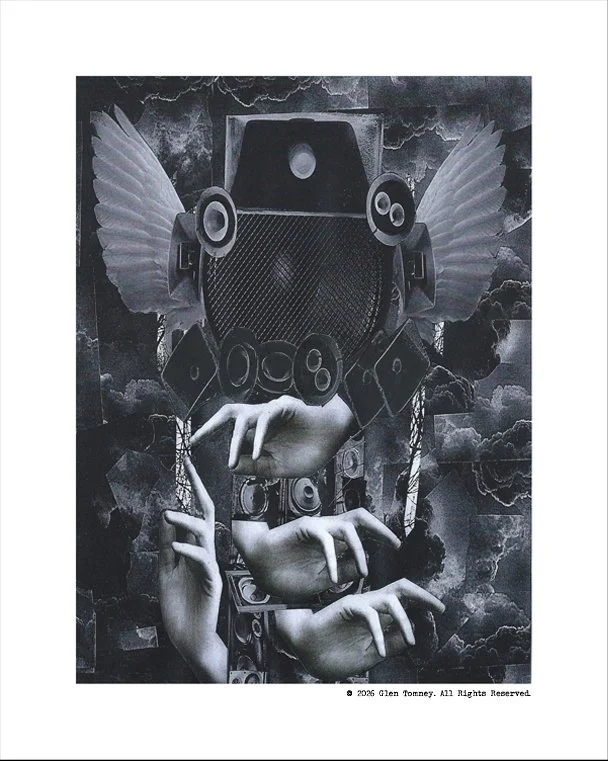
The name for this piece is derived from the character of Nicholas in Brian Catlings book The Cloven, which is part three in the Vorrh trilogy. Nicholas, who is a kind of eccentric angel, engages himself in listening to his crystal-set radio and finds delight in hearing the voices inside it. He refers to the signals as the “singing wires”.
I wanted to work on something that conveyed the imagery of transmissions portrayed as a totem. Before the piece’s creation, I viewed and listened to music and dramas in which wave and static noise was used to invoke moods and to add a dramatic feeling - namely David Lynch’s works, with regards to his use of sampling from experimental ambient and post rock bands.
Static is the sound of old analogue TV or radio. It contains 1% of what is called cosmic microwave background - the leftover radiation and thermal afterglow of the big bang.
Atomic Lophophora
Collage, cut-and-paste and digital media.
In my early twenties, I, like many other people I knew at the time, read Carlos Castenada’s The Teachings of Don Juan, A Yaqui Way of Knowledge. This Peruvian American author wrote of meetings that developed into Castenada becoming apprentice to Don Juan Matus, a Yaqui Indian sorcerer. In this apprenticeship, Castenada gathered data about his experiences using spiritually and medicinal plants, with peyote being one of these. It has been debated and argued that Castenada’s world was largely fictional, but never-the-less, it would seem that the experiences of using peyote to gain guidance as a balance for spirituality are very real.
I had also read the book Crow Dog: Four Generations of Sioux Medicine Men by Leonard Crow Dog and Richard Erdoes. For Crow Dog, peyote stood for unity for all people despite varying religions or ceremonies, “different tribes have peyote” in Crow Dog’s words “it makes them one”. It is known that it elevates the mind in such a way as to lift it into new dimensions. Whilst I’m not advocating its use, it is a sacred sacrament to the Native Americans who lived within the natural world and honoured, feared and respected it.
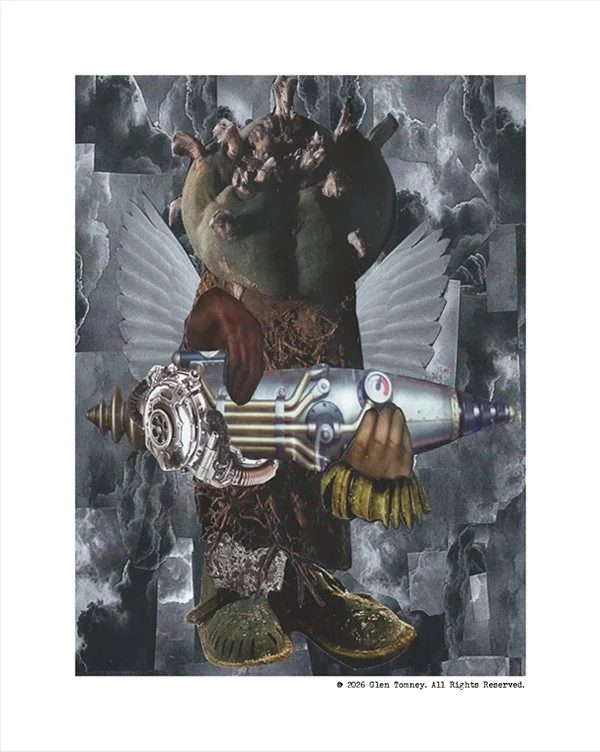
Atomic explosions happen with an uncontrolled release of energy which occurs through nuclear fission. I wanted to make an image that showed power that had the impact of what an explosion would be like if invoked by the ingestion of the cactus on a persons psyche. To put a face to a name Atomic Lophophora.
I wanted to make an image that compared the power of that explosion to the effect on a persons psyche as invoked by the ingestion of the cactus.
Full Assault
Collage, cut-and-paste and digital media.
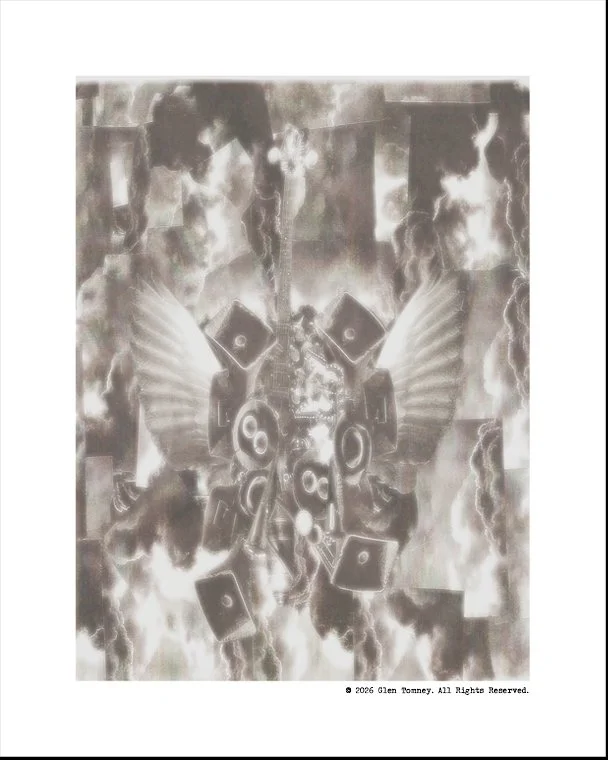
John Cipollina played guitar for sixties band “The Quicksilver Messenger Service”. He developed a one-of-a-kind Amplifier stack which consisted of two Standel amplifiers equipped with fifteen inch speaker cabinets. Treble pick ups fed into fender duel showman speakers which drove the sound through Wurlitzer horns.
This system is now in the American rock n roll hall of fame. The design was one of the main influences for putting this collage together.
To show a system levitating on feathered wings like a sound ship was my vision for its construction.
To uplift with “ Full Assault”.
Remote Viewer
Collage, cut-and-paste and digital media.
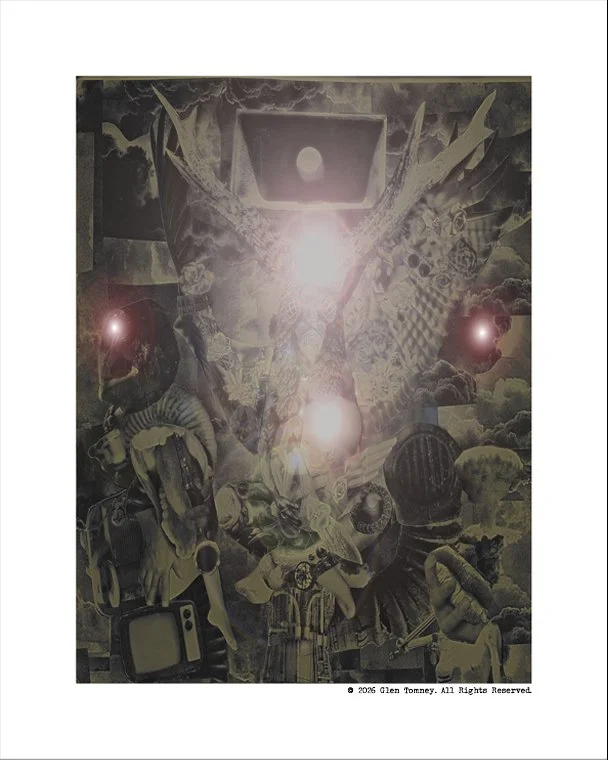
The definition of a “remote viewer” or “remote viewing” is that it is an alleged psychic ability to see or sense a hidden target, place or person that is far away. Mainstream science views this as pseudo science because it doesn’t give sold proof, yet meditation encourages deep visual thought by the use of yantra symbology as guides for transcendence.
What interested me was the assumption that a remote viewer would be human, so I wanted to create an image that viewed humanity as the target - seen from an alien mindset.
The Harvester
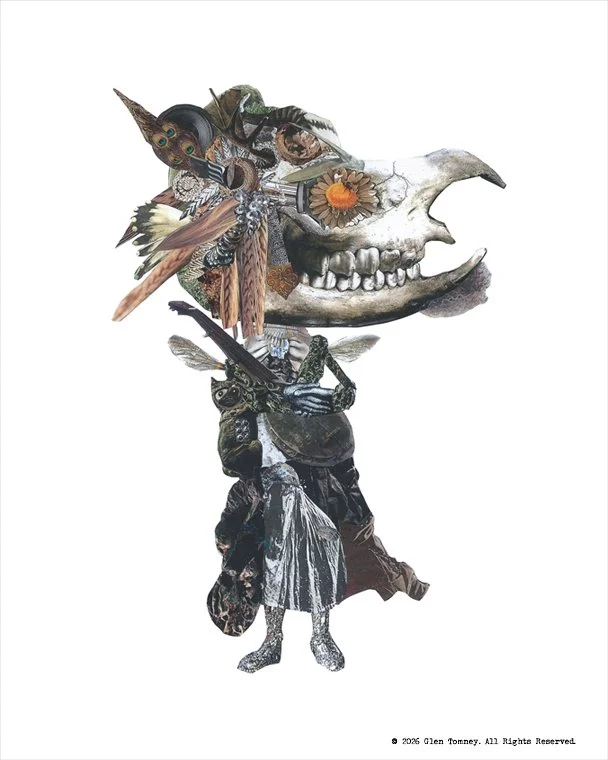
Collage- cut and paste 2024.
Since the 14th century, European art connected the physical features of death to the character of the Grim Reaper.
The scythe had deliberate agricultural associations. The tool symbolised the removal of human souls from their bodies, with the analogy being the farmer (Reaper) cutting through swaths of grain crops during harvest. The Grim Reaper as a soul collector has been used countless times in Storytelling, folklore, and film, but my interpretation was partly influenced by the Welsh customs of “the Mari Lwyd”. I also loved the late author Terry Pratchett’s interpretation of the character as '“just a guy who has a job to do”, kind of like Woody Allen’s take on the reaper in his film, Love and Death. For some reason, he plays a flailing banjo lament before the big chop, who knows?
Junk-Yard Fat Suit
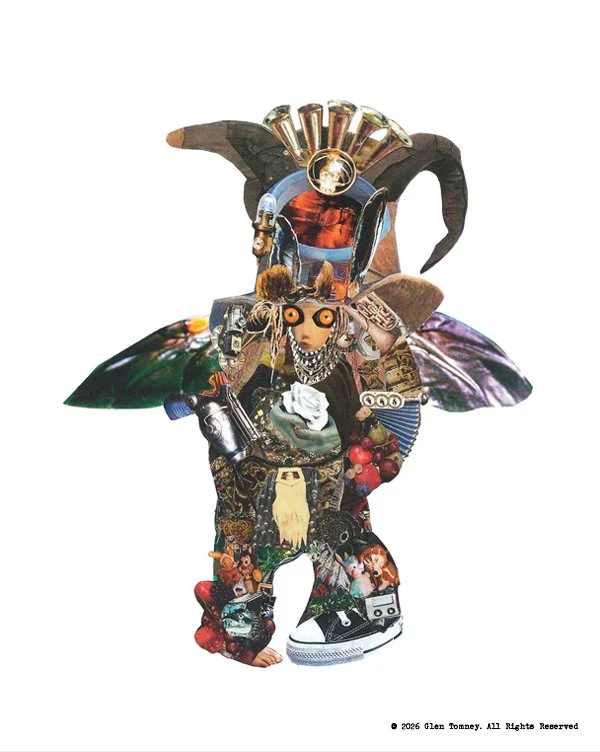
Little Mermaid
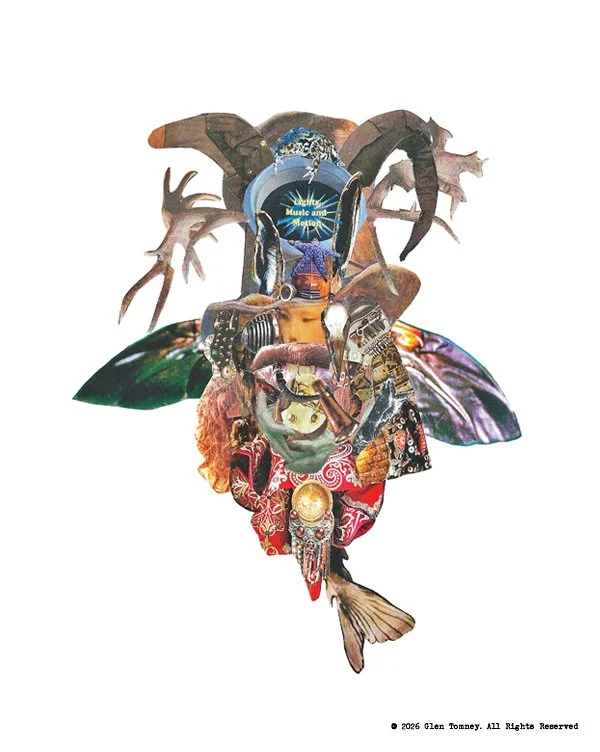
Norri’s Sister
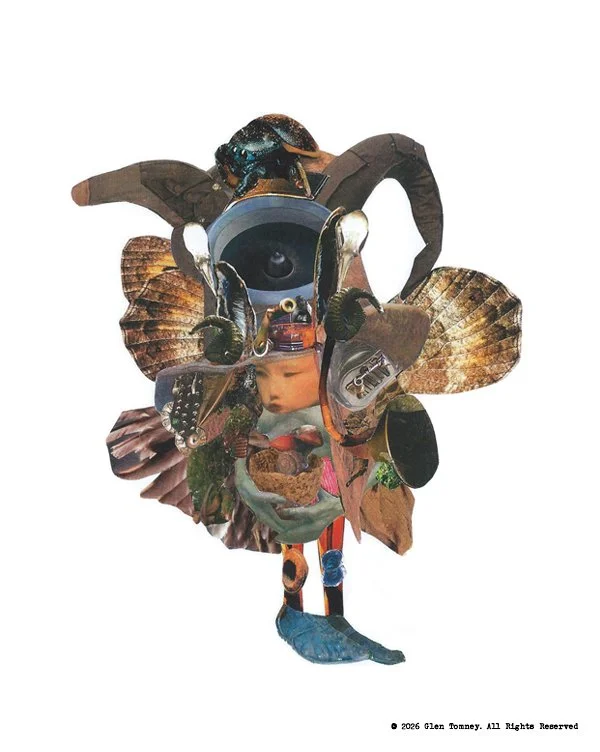
In the book Into the Mylar Chamber by Ira Cohen www.fulgur.press Cohen uses reflective “mylar” mirrors which he built into walls in his apartment. The reflections created by these specialist flexible mirrors created visual distortion. He would sometimes use scatter cushions for comfort, costumes and props and photograph human subjects in a visually interesting way.
The characters I have created owe a debut to Cohen’s study, as the face I used was that of a Japanese geisha with her features distorted by the mylar effect. I copied the image and created this trio of supernatural beings, using the same face in all three images. Eyes and lips were changed to match the quirks of each character’s individual eccentricity.
The designs are somewhere between New Orleans Mardi-Gras costumes and Ken Dod’s Dicky Mint puppet. They are stunted, quirky and psychedelic in their own way and this was the aim. Nordri’s Sister, the Little Mermaid and Junk-Yard-Fat Suit will all appear in the book of Nordri which will be my project in 2027.